
Signal Among Noise: What a 2.75-Magnitude Tremor Tells Us About the Limits of Intelligence

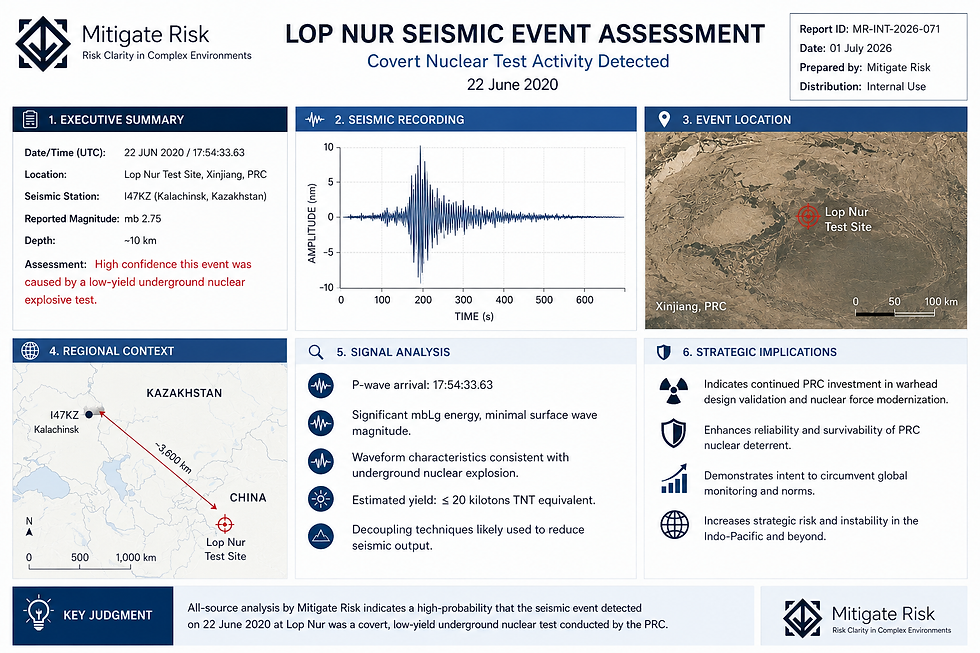
Thesis: The core failure mode in intelligence work is not a shortage of data but the inability to separate a meaningful signal from an ocean of irrelevant noise — and the 2020 seismic event at Lop Nur, only publicly attributed to a covert Chinese nuclear test in 2026, is a live case study of a signal that took years to be heard at all.
The Problem Is Not Secrecy. It's Volume.
The classic starting point for this argument is Roberta Wohlstetter's Pearl Harbor: Warning and Decision (1962). Wohlstetter's central finding, after exhaustively reconstructing the intelligence picture available to U.S. analysts before December 1941, was that the warning signs were present in the data the whole time. The failure was not an absence of information; it was that the relevant signals were "buried in a highly confusing noise" of competing, contradictory, and simply irrelevant material. Her conclusion — "we failed to anticipate Pearl Harbor not for want of the relevant materials, but because of a plethora of irrelevant ones" — reframed intelligence failure as a filtering problem rather than a collection problem, and it has shaped warning doctrine ever since.
Nate Silver picked up the same framework fifty years later in The Signal and the Noise (2012), applying it beyond military intelligence to forecasting broadly: "The signal is the truth. The noise is what distracts us from the truth." Silver's argument is that more data does not automatically produce more clarity — in fact, as the volume of ambient information grows, the ratio of signal to noise typically gets worse, not better, unless analytic discipline improves in step.
Why Analysts Miss What's in Front of Them
Richards Heuer's Psychology of Intelligence Analysis (CIA Center for the Study of Intelligence, 1999) supplies the mechanism. Heuer argued that most analytic failures happen not because the signal was absent from the record, but because cognitive biases — anchoring, confirmation bias, the availability heuristic — cause analysts to discount, misread, or ignore it. His prescription, structured techniques like Analysis of Competing Hypotheses, exists precisely because the unaided human mind is a poor noise filter under uncertainty.
Cynthia Grabo's Anticipating Surprise: Analysis for Strategic Warning (declassified from her 1972–74 DIA handbooks) narrows this further into the specific discipline of indications and warning intelligence. Grabo, who spent decades on the U.S. Watch Committee, insisted that strategic warning is rarely a single dramatic indicator; it is a low-grade pattern of small, ambiguous signals that only cohere in hindsight, and that the job of the analyst is to resist waiting for certainty before flagging them.
The Case: A Waveform Twelve Seconds Long
Lop Nur fits this literature almost too neatly. On June 22, 2020, the International Monitoring System station at Makanchi, Kazakhstan — part of the global network built under the Comprehensive Nuclear-Test-Ban Treaty to catch exactly this kind of event — recorded a 2.75-magnitude seismic signal roughly 450 miles from China's primary nuclear test site. The CTBTO logged "two very small seismic events, twelve seconds apart," but stated plainly that the data alone could not establish cause. It took years of additional analysis before the U.S. State Department publicly assessed, in February 2026, that the event was consistent with a nuclear explosive test, allegedly concealed through "decoupling" — detonating underground in a large cavity to dampen the shockwave and blend the signal into background seismicity. China has denied it outright. The signal, in other words, was captured in real time. What took years was deciding what it meant — and whether it meant anything at all.
Why This Matters Now
The stakes of this filtering problem are rising, not falling. Sensor networks — seismic, satellite, signals, open-source — now generate far more raw material than any human analytic workforce can review, which is exactly the condition Wohlstetter and Silver warn produces worse discrimination, not better. Arms-control verification in particular depends on distinguishing deliberately disguised low-yield activity from geological background noise, a technical and interpretive problem that will only get harder as decoupling and other concealment methods improve. And as more states approach the threshold of next-generation weapons that require validation beyond simulation alone, the number of small, deniable, technically ambiguous signals in the system is likely to grow, not shrink. The intelligence industry's next hard problem is not acquiring more sensors. It's building the analytic discipline — Heuer's structured techniques, Grabo's tolerance for acting on ambiguity — to hear the signal before the noise buries it for another six years.
A Question Worth Sitting With
If it took six years to publicly connect a twelve-second seismic anomaly to a nuclear test, how many comparable signals are sitting in classified — or even unclassified — archives right now, waiting for someone to notice the pattern?
References
Wohlstetter, R. (1962). Pearl Harbor: Warning and Decision. Stanford University Press.
Silver, N. (2012). The Signal and the Noise: Why So Many Predictions Fail — But Some Don't. Penguin Press.
Heuer, R. J., Jr. (1999). Psychology of Intelligence Analysis. Central Intelligence Agency, Center for the Study of Intelligence.
Grabo, C. M. (2002/1972–74). Anticipating Surprise: Analysis for Strategic Warning. Joint Military Intelligence College, Center for Strategic Intelligence Research (declassified DIA handbooks).
NPR (2026, February 17). "U.S. releases new details on alleged secret Chinese nuclear test."
Comprehensive Nuclear-Test-Ban Treaty Organization (CTBTO), public statement on the June 22, 2020 Lop Nur seismic events.


Bài bạn viết ngắn gọn mà dễ nắm, mình đọc một lượt là hiểu ý ngay, cảm ơn bạn đã chia sẻ để mọi người có thêm chỗ tham khảo. Mình cũng có thói quen xem thống kê XSMB hằng ngày cho tiện theo dõi, nhưng hồi trước cứ phải mở nhiều nơi khác nhau nên khá mất thời gian và dễ rối. Gần đây mình hay lướt qua https://soicau247.com/soi-cau-du-doan-xsmb-chinh-xac-100.html rồi tự lọc lại những con số mình quan tâm, ghi vào một trang riêng để lúc cần chỉ việc mở ra xem nhanh. Làm vậy chủ yếu để đỡ quên và khỏi phải tìm lại từ đầu. Ai cũng cập nhật theo ngày như mình chắc sẽ thấy cách…